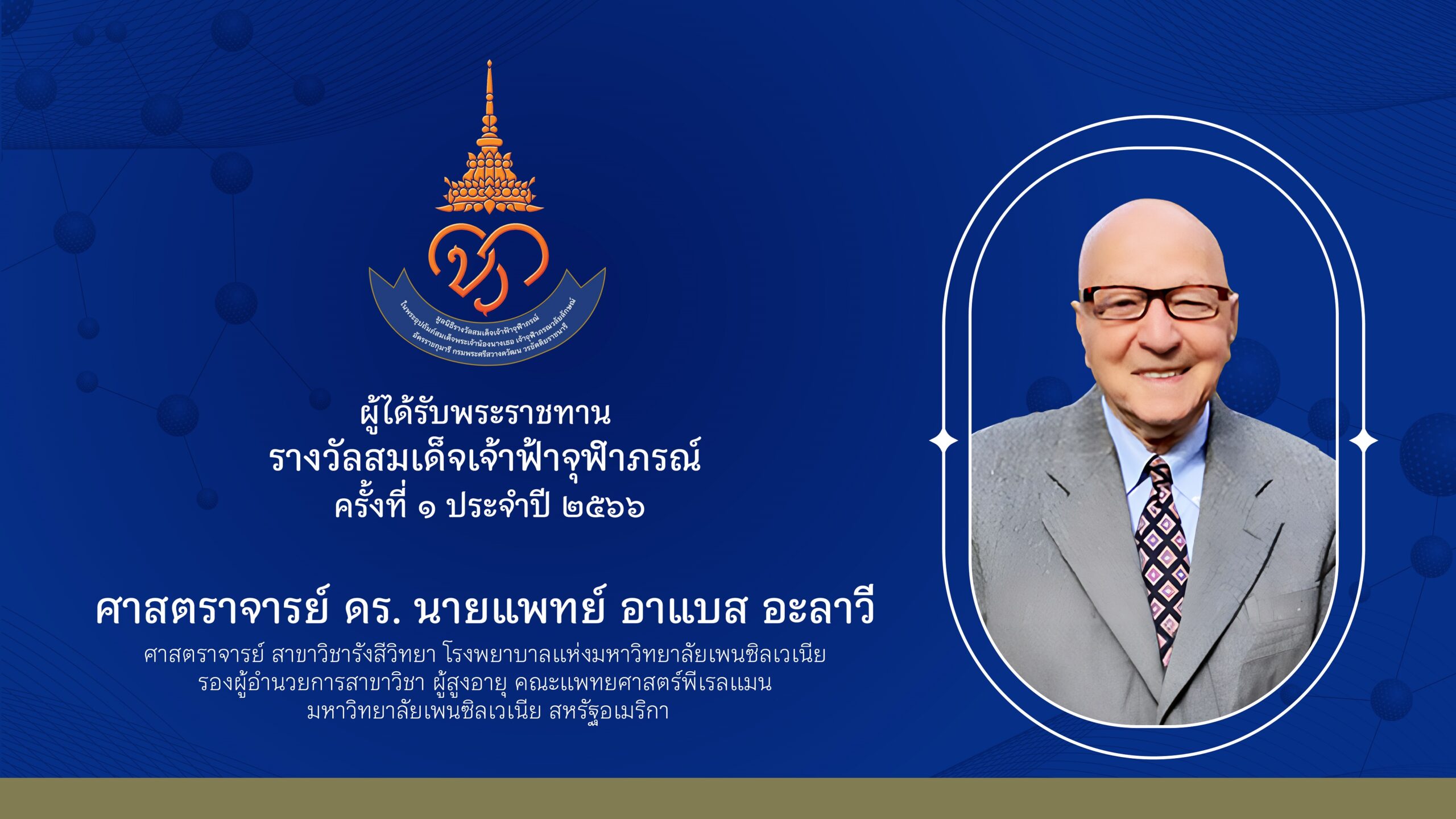
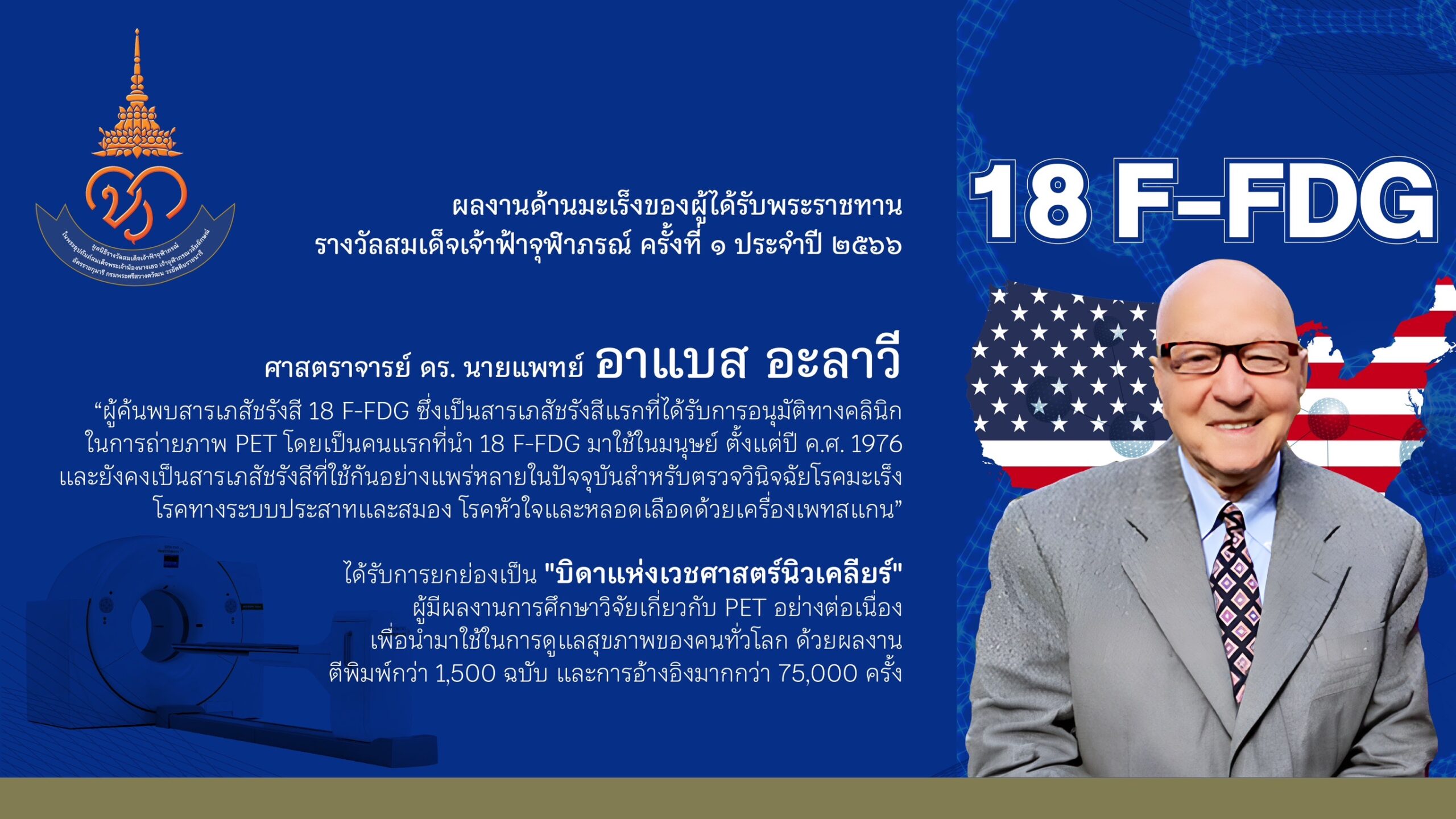
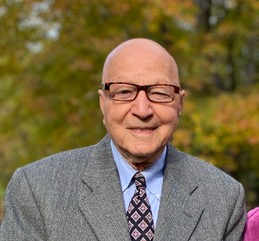
Professor Abass Alavi, M.D., an Iranian-American physician-scientist, is recognized as the “father of nuclear
medicine”. He is internationally renowned as a pioneer in molecular and nuclear imaging, having contributed to the
development of positron emission tomography (PET), in particular utilizing the radiotracer fluorine-18 Fluorodeoxyglucose
(FDG) in PET imaging. This enhances the effectiveness in diagnosis and follow up of the treatment of many diseases in
particular cancer.
Professor Abass Alavi received his Doctor of Medicine from School of Medicine, University of Tehran, Iran in
1964. He undertook resident training in Internal Medicine at Albert Einstein Medical Center and Veterans Administration
Hospital in Philadelphia and residency training in Radiology at Beth Israel Deaconess Medical Center, Boston. He was then
trained in sub-specialty in Hematology in 1970 and in Nuclear Medicine in 1973, both at the hospital of the University of
Pennsylvania, Philadelphia.
Professor Abass Alavi had his first faculty appointment as an instructor in Radiology, University of Pennsylvania,
School of Medicine in 1973 and from 1982 up to present he is Professor in Radiology and Neurology. He was also appointed
as Professor of Psychiatry between 1987-2000. In addition to teaching, research, and clinical work, Professor Abass Alavi also
holds hospital and administrative positions. At present he is the Director of Research Education, Department of Radiology,
and Associate Director, Center for the Study of Aging, at University of Pennsylvania.
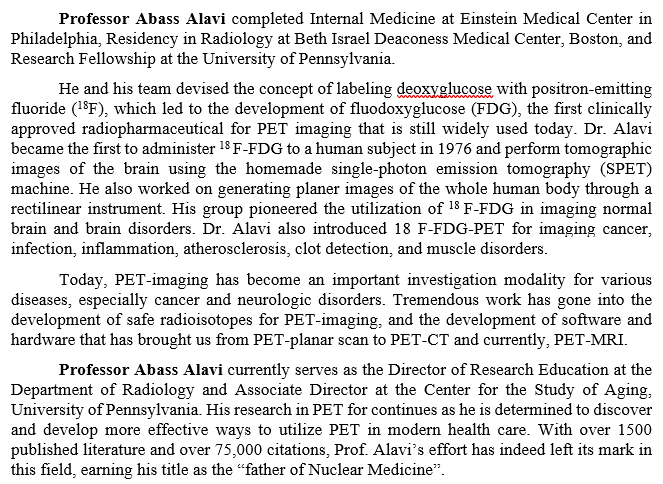
In 1973 Professor Abass Alavi along with tomography pioneer Dr. David Kuhl and neurologist Dr. Martin Reivich
devised the concept of labeling deoxyglucose with positron-emitting (Fluorine-18, 18F), which originated the development of
fluorodeoxyglucose (FDG), In August 1976 the team performed the first human PET studies of the brain and whole-body
using Fluorine-18 FDG. FDG then becomes the first clinically approved radiopharmaceutical for PET imaging which has been
the dominant tracer and has remained so for over 40 years now. These efforts led the groundwork for use of FDG to improve
earlier detection and better treatment for millions of patients with dementia, brain trauma, schizophrenia, cancer and other
disorders.
In addition to the development of FDG, Professor Abass Alavi was among pioneers in using iodine-123 in the
diagnosis of thyroid cancer, meta-iodobenzylguanidine in the assessment of pheochromocytoma, radiolabeled white blood
cells in the evaluation of infection, and technetium 99m (99mTc) for the detection of gastrointestinal bleeds. Professor Abass
Alavi, together with his wife, Dr. Jane Alavi, a specialist in hematology and oncology and Emeritus Associate Professor of
Medicine at the University of Pennsylvania pioneered the use of Fluorine-18-FDG PET for the demonstration of recurrent
brain tumors.
Over the course of his career, Professor Abass Alavi has published over 1,400 international peer-reviewed journal
articles, along with nearly a hundred books, detailing his research findings in single photon emission computed tomography
(SPECT), positron emission tomography (PET), computed tomography (CT) and magnetic resonance imaging (MRI). His
works have been cited over 83,000 times and his h-index stands at 138. Professor Abass Alavihas served as editorial boardfor
a number of prestigious journals including Journal of Nuclear Medicine, European Journal of Nuclear Medicine, and
Molecular Imaging, Journal of Experimental & Clinical Cancer Research, Annals of Nuclear Medicine and Sciences, and
International Journal of General Medicine. He also serves as manuscript reviewer, members of several committees/society at
national and international levels and speakers globally. Professor Abass Alavi has supervised more than 130 graduates which
further contribute to the advancement of medicine in addition to his own work.
As a clinician, mentor and researcher, Professor Abass Alavi has received numerous awards, for example,
Outstanding Service to the Cause of Cancer Control, Acknowledgement by American Cancer Society (2000), Georg Charles
de Hevesy Nuclear Pioneer Award (2004), Best Mentor Award, American College of Nuclear Physicians (2006), Benedict
Cassen Prize for Research in Nuclear Medicine of Society of Nuclear Medicine and Molecular Imaging (2012), the first Gold
Medal from the Ministry of Health, Iran (2016), Gold Medal, American College of Nuclear Medicine (2017) and Lifetime
Achievement Award, the Society of Nuclear Medicine, India (2022). To celebrate his achievement in 2015, Tabriz University
in Iran has also established Alavi International Institute of Aging in his name.
Professor Abass Alavi continues to work on PET with the intention to see the advancement of PET in contributing to
the health care of people. With the achievements of Professor Abass Alavi being evident and still widely used today around
the world, the Board of Trustees of the Princess Chulabhorn Award deems that Professor Abass Alavi truly deserves the honor
of being conferred with the Princess Chulabhorn Award for the year 2023